Rabu, 25 Februari 2015


DAFTAR TOKO YANG MENERIMA BITCOIN DI INDONESIA


Di Indonesia saja ada lebih dari 10 tempat di mana kita bisa berbelanja dengan menggunakan Bitcoin. Berikut daftarnya:
Upstairs bar & café
Cikini Raya no. 45
Cikini — Jakarta
Symbian
Toko Telepon Seluler
Jln. Moneng Sepati, No.66
Lubuk Linggau — Sumatera Selatan
Dwijaya Photographer
Jl. Muhtar Lutfi No. 14
Bulukumba — Sulawesi Selatan.
PT. Sinar Daku
Pabrik Selang PVC
Jl Prof Dr Latumenten Gg Hasbilan 3 no 11
Jakarta Barat 11330 — DKI Jakarta
BTC-indo.com
situs online yang menjual Berbagai Macam Bitcoin Asic Miner
Jakarta & Surabaya
Elektronika-sakinah
Aksesoris HP
Jakarta Timur — DKI Jakarta
Seta Moda
Toko tekstik & service fashion design
Ruko Paskal Hypersquare B-69, Jl. Hos Cokroaminoto (Pasir kaliki) — Bandung
Wijaya Motor
Dealer & Bengkel Resmi Sepeda Motor Honda
Jl. Jendral Sudirman 257 — Bandung
MVT (www.magicinkremover.com)
Toko online penghapus tinta
Jakarta
Semesta Rental Car
Menyewakan Kijang Innova, All New Avanza dan All New Xenia. Lengkap dengan sopir.
Bisa keliling dalam kota maupun luar kota.
Jalan Utari 1B no. 1. Pondok Indrapasta, Semarang. HP: 0821 3678 9758
Uang Kuno (uangkuno.net)
Online shop yang melayani jual beli uang kuno
FastCell (fastcell.net)
Pulsa, voucher game, token PLN
Faiyo (faiyo.net)
Toko online distro pertama di Indonesia yang menerima bitcoin
CilukBa (cilukba.co.id)
Online shop berbagai baju anak dan mainan anak
Grosirmu (grosirmu.com)
Online Shop berbagai peralatan rumah tangga, fashion dan kebutuhan lainnya
Republik Host (republikhost.com)
Layanan hosting dan domain
Hobi House (hobihouse.com)
Online shop berbagai perlengkapan souvernir, goody bag dan bedding set bayi dan anak
Cinta Bahasa Indonesia Language School (cintabahasa.com)
Kursus Bahasa Indonesia
Bali
Perkakasku.com
Jual segala macam perkakas secara online dan offline. Sempet diliput techinasiahttp://id.techinasia.com/perkakasku-ecommerce-pelopor-perkakas-indonesia/Jl Ahmad Yani no 350
Bandung
Pho.bi.a Shop
Boutiq pakaian dan asesoris wanita
Jl. Kemuning no 11
Bandung
Delmare Snack
DBS Tower, Gepi Office, Lantai 9. Ciputra World 1,
Jalan Prof. Dr. Satrio Kav 3-5
Jakarta
Mau Tuku
Taman Sentosa Blok D12/19
Cikarang

APA ITU BITCOIN?


Dulu orang bertransaksi dengan cara barter. Cara barter ini tidak efisien karena cukup susah juga cari orang mau menukar sesuatu yang kita miliki dengan keinginan kita.
Lalu dicarilah sesuatu yang diterima bersama sebagai alat tukar. Sesuatu itu harus awet, mudah dibawa, langka dan tentunya diterima banyak orang. Ditemukanlah logam berwarna kuning yang bernama emas yang digunakan sebagai alat tukar.
Karena menyimpan dan membawa emas dirasa masih cukup merepotkan. Di pasar-pasar tersedia jasa penitipan emas bernama BANK. Dimana emas yang kita miliki dapat kita titipkan di Bank dan kita diberikan kertas sertifikat bukti penitipan emas. Kertas sertifikat ini adalah cikal bakal uang kertas modern. Pada saat itu Bank mendapatkan keuntungan dari jasa penitipan emas dan bunga dari mereka yang meminjam pada Bank.
Lama kelamaan uang kertas tidak lagi dijamin dengan emas. Tetapi diterbitkan dengan jumlah yang diatur oleh Bank Sentral. Sebagai pengguna uang kita percaya sepenuhnya pada Bank Sentral sebagai penerbit uang. Kita percaya Bank Sentral dengan bijak menerbitkan uang, mengatur tingkat suku bunga dengan baik dan mengeluarkan kebijakan-kebijakan moneter yang baik. Jika Bank Sentral melakukan kecurangan dan tidak lagi dipercaya, maka mata uang yang diterbitkan pun tidak laku.
Pada tahun 2008 Satoshi Nakamoto menemukan ide sebuah alat tukar digital yang tidak diatur oleh bank sentral (atau otoritas apapun) dan memiliki konsep & sifat-sifat yang persis seperti logam mulia. Alat tukar digital ini bernama Bitcoin. Bitcoin dihasilkan seperti emas bahkan memiliki sifat-sifat persis seperti emas yang langka, awet dan mudah di bawa kemanapun. Selain itu Bitcoin juga mudah dibagi ke dalam jumlah yang lebih kecil, mudah dikirim ke seluruh dunia dengan cepat, dan anonim.
Bitcoin bukanlah sebuah bisnis, perusahaan apalagi money game. Bitcoin adalah komoditas digital yang dapat dijadikan alat tukar. Sebuah logam mulia digital.
Bagaimana Memulainya?
Buat sebuah dompet Bitcoin. Ada banyak pilihan Dompet Bitcoin. Silahkan Pilih dompet Anda.
Dompet Bitcoin (Bitcoin Wallet) adalah aplikasi yang digunakan untuk mengirim, menerima dan menyimpan Bitcoin.
Bagaimana Mendapatkan Bitcoin?


Pertanyaan ini sama seperti “Bagaimana Mendapatkan Emas?”
Sama seperti emas, Bitcoin dapat diperoleh dengan cara:
  • “Menambang”
  • Membeli
  • Menjual barang atau jasa dengan Bitcoin
  • Bekerja lalu minta dibayar dengan Bitcoin
  • Meminta
  • Mencuri, merampok, menipu, dsb :-P
Bagi Admin, membeli adalah cara termudah mendapatkan Bitcoin. Bitcoin dapat dibeli melalui “toko” atau mesin yang melayani jual beli Bitcoin, dapat juga Anda beli dari orang-orang yang menjual Bitcoin, atau bisa juga melalui Exchange (Bursa Bitcoin) dimana Bitcoin diperjual belikan di sana melalui sistem lelang.

Bursa Bitcoin
Admin paling sering membeli dan menjual Bitcoin melalui Bursa Bitcoin karena harganya yang paling kompetitif. Dulu ketika Admin pertama kali mengenal Bitcoin, hampir tidak ada orang menjual Bitcoin di Indonesia sehingga Admin terpaksa membeli dari luar negeri. Ketika itu bursa jual beli Bitcoin di dunia juga masih sedikit. Salah satu yang terbesar ketika itu adalah Mt. Gox yang sekarang sudah bangkrut. Saat ini di Indonesia sudah terdapat Bursa Bitcoin yang beroperasi di Indonesia dan menggunakan Rupiah dalam transaksinya. Salah satu favorit Admin adalah Bitcoin Indonesia milik pak Oscar Darmawan, karena saat ini cuma itulah Bursa Bitcoin di Indonesia yang volume transaksinya lumayan. Dalam Bursa Bitcoin kita dapat langsung membeli dan menjual Bitcoin dari orang lain melalui sistem lelang, persis seperti bursa saham. Bursa Bitcoin Indonesia buka 24 jam sehari dan 7 hari seminggu.

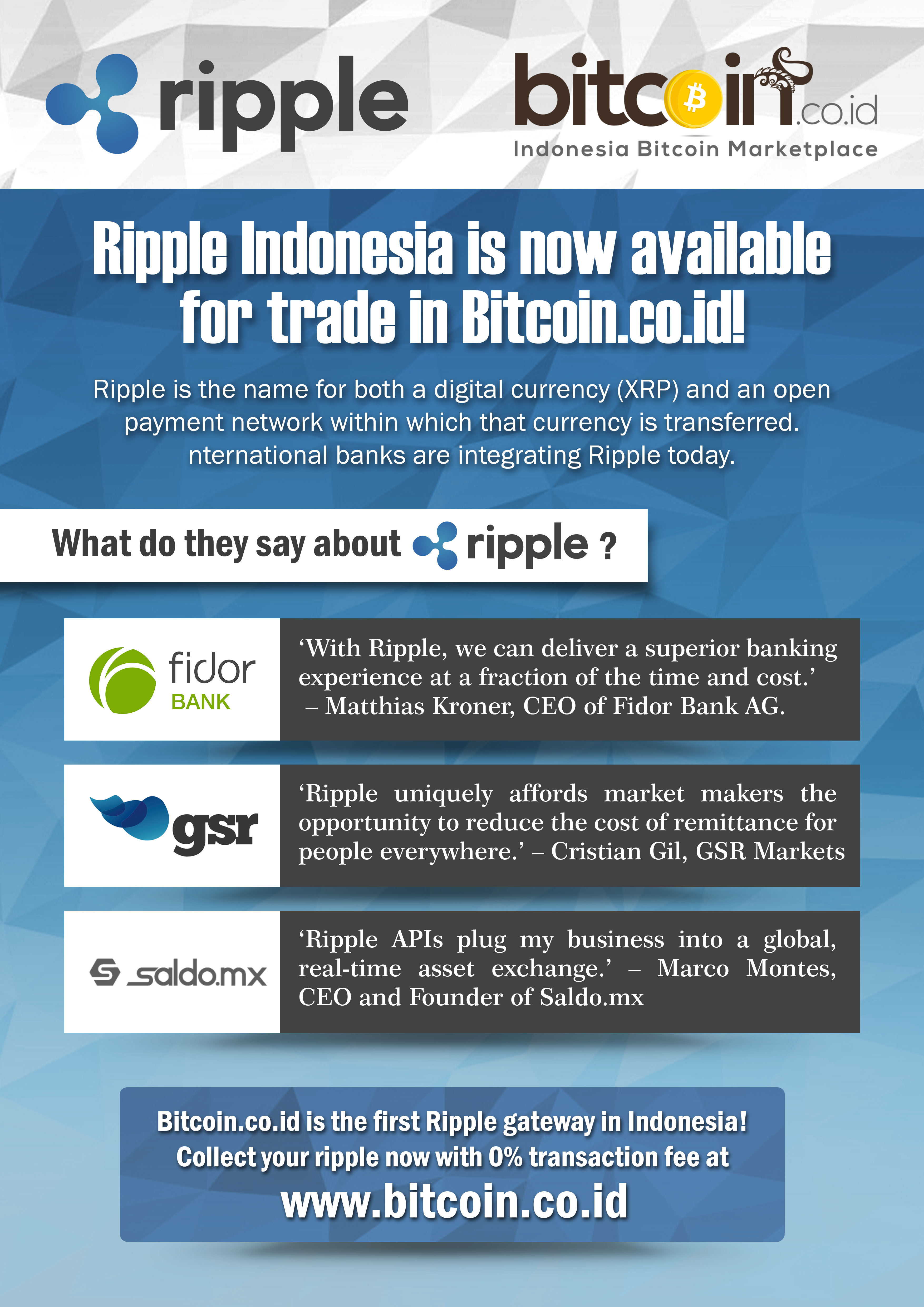
Poster Ripple
Mulai hari ini, Bitcoin.co.id secara resmi membuka pasar baru dimana Anda dapat menukar Bitcoin dengan salah satu Alternate Coin yang paling terkenal, yaitu Ripple! Bagi Anda yang belum memahami betul apa itu Ripple, kami akan membahasnya secara singkat di dalam artikel ini.
  • Apa itu Ripple?
Ripple adalah nama mata uang digital yang serupa dengan Bitcoin, sekaligus nama sistem pembayaran global yang terhubung dengan berbagai mata uang di dunia. Satuan mata uang yang keluar dari teknologi Ripple, dikenal dengan nama XRP. Teknologi ini memudahkan para pengusaha, perusahaan, dan masyarakat dunia untuk mengirim, menerima, menjual atau membeli berbagai mata uang tanpa harus lagi khawatir dengan biaya transaksi yang mahal atau waktu delay yang lama.
  • Bitcoin VS Ripple
Seperti Bitcoin, XRP milik Ripple juga merupakan mata uang digital yang berdasar pada formula matematika dan memiliki suplai coin terbatas. Selain sama-sama dijaga oleh keamanan tingkat tinggi, cara kerja kedua mata uang digital ini pun sama, yaitu peer-to-peer tanpa mengandalkan pihak ketiga. Oleh karena itu, pengiriman uang bisa dilakukan dengan biaya transaksi yang sangat kecil dan cepat. inilah yang dimanfaatkan oleh masyarakat.
Terdapat sedikit perbedaan antara Bitcoin dan Ripple. Teknologi Bitcoin hanya mendukung pengiriman Bitcoin antar sesama pengguna. Jika Anda ingin menguangkan Bitcoin ke mata uang lokal negara Anda, maka Anda harus mencari exchange atau Bitcoin user lain yang mau menukarkan Bitcoin Anda ke mata uang lokal. Jika Anda menggunakan Ripple, Anda tidak perlu lagi repot-repot mencari tempat untuk menjual mata uang digital Anda karena teknologi Ripple memfasilitasi pertukaran XRP dengan berbagai mata uang di dunia, termasuk Bitcoin.
  • Kelebihan Ripple
Selain memiliki teknologi dan jaringan yang men-support berbagai mata uang negara di dunia, Ripple juga memiliki misi untuk merobohkan dinding-dinding yang membatasi pembayaran dalam dunia finansial. Seseorang yang menggunakan PayPal, misalnya, hanya bisa mengirim uang kepada sesama pengguna PayPal atau berbelanja di situs-situs yang telah bekerjasama dengan PayPal. Hal yang sama terjadi dimana pengguna MasterCard hanya bisa berbelanja di toko-toko yang memiliki mesin EDC MasterCard. Setiap sistem pembayaran yang ada, pasti diciptakan dan bekerja dengan caranya sendiri sehingga antara satu sistem dengan sistem lain tidak bisa dihubungkan secara langsung. Seseorang yang menerima pembayaran dalam Bitcoin, tidak bisa menerima pembayaran dengan Credit Card tanpa mesin EDC. Sebaliknya, merchant dengan mesin EDC tidak bisa menerima Bitcoin jika mereka tidak mempunyai wallet Bitcoin. Ripple hadir untuk memperbaiki situasi seperti ini.
Kini bank-bank besar dunia seperti Fidor Bank, GSR Markets dan Saldo.mx sudah berintegrasi dengan teknologi Ripple untuk memudahkan proses pengiriman uang antarnegara atau remittance, serta memudahkan para pengusaha untuk mengembangkan bisnis mereka. Meskipun market cap Ripple belum sebesar Bitcoin, tetapi Ripple sudah menduduki posisi kedua setelah Bitcoin dalam jajaran seluruh mata uang digital yang ada di dunia.
Jika Anda tertarik untuk memiliki Ripple, Anda bisa menukarkannya dengan Bitcoin tanpa membayar biaya transaksi sedikitpun di www.bitcoin.co.id.

Genesis Mining

This year has seen the arrival of a number of “cloud” mining services - companies that will sell you mining contracts and pay you out with the proceeds. Generally this means you’re renting mining hardware directly, and you get paid out with whatever that hardware produces.
Genesis Mining is a bit different, in that you don’t rent the hardware directly. Instead, you get a contract for a set amount of hashing power, which you can target against various alt-coins like DarkCoin, LiteCoin, etc.  At the end of the day, Genesis Mining converts your mining efforts back into Bitcoins and pays out into your own wallet.
The site has a nice dashboard that lets you allocate your hashing power to one or more alt-coins, or just set it to auto and they’ll calculate the most profitable coin to mine for you.
I signed up a bit over a month ago, and purchased a total of 6 MH/s, for 1.52954788 BTC, or about $940 USD at the time.  I’ve left the mining set to “auto”, so Genesis Mining can figure out which coin is the most profitable.
Here’s what my payouts have looked like since then (the date format is dd.mm.yyyy):
While I’ve made back 0.351144 (23% of my initial investment) in a bit over a month, you can see that payouts are definitely trending down. I’m happy with the payouts so far, but I would like to know, on a daily basis, just what my MH/s are being used to mine.
I’ll update again in the future to show how it’s going. Hopefully, I’ll at least break even by the 6 month-mark.

Easy ways to earn Bitcoin for Beginners

The following is a guest post, written by John Delano.
Bitcoin has recently gained a lot of awareness from the press, due to its exponential price growth. People from all over the world are beginning to use the digital currency, looking to strike it rich, or simply take advantage of its unique features.

Scrape Bitcoin faucets

Bitcoin faucets have played an essential role in the history of Bitcoin. Faucets are websites which automatically dispense free BTC to a user who enters his or her Bitcoin address. This is an ideal way for newbies to get a small amount of BTC for free.

There are many different faucet websites, each with its own unique features. For example, some websites require players to complete a simple game, instead of solving a boring old CAPTCHA. A number of Bitcoin casino sites give out coins which can be used to bet on a dice roll or sports event. You could potentially earn a lot more from these sites, compared to regular faucets.

Mine Bitcoin

Mining is the process of generating Bitcoins through solving computationally-difficult problems. It also serves the purpose of confirming transactions, which secures the network. In layman’s terms, this simply means that you can use computers to crunch numbers, and earn BTC as a reward.

Bitcoin mining is actually a lot harder than it sounds. In 2009, when the virtual currency was first released, you may have been able to mine hundreds of BTC with any regular computer effortlessly. Today, miners employ specialized devices in a race to earn the 25 BTC block reward. In fact, the Bitcoin network is around 256 times faster than the world’s top 500 supercomputers combined.

So is it possible for ordinary people like you and me to take part in the Bitcoin gold rush? The answer is simple. You can join a mining pool to work with other miners, and then split the reward based on how much computational work you did. USB-powered mining hardware, such as the ASICMiner Block Erupter, are readily available, and affordable to the average Bitcoin user. Although there is a chance that you won’t make back the money you spent on purchasing hardware, you will still learn how Bitcoin works, and earn some extra money along the way.

Sell goods and services

Instead of simply purchasing Bitcoins on an exchange, you can also earn it through selling useful items and services to the community. If you’d like to sell something, you should consider accepting Bitcoins, instead of simply listing the item on eBay. Even a number of Subway shops now accept BTC as payment.

One of the key features of Bitcoin is that it allows you to send and receive money from anywhere in the world. That means that you could make money by providing useful services to international customers. If you are skilled at a particular job, such as programming, or graphics design, you could earn a good amount of Bitcoin doing freelance work.

John Delono is a passionate Bitcoin user. He first learned about it in 2010, when looking for a way to make online payments, and store his money safely. He is excited by Bitcoin’s potential to change the world economic system. He writes about Bitcoin gambling on his website, Bitcoin Reviewer.

Comparing Bitcoin Desktop Clients

A Bitcoin desktop client is software that you run on your own computer, as compared to an online client which is a service that makes your wallet available online.  With a desktop client, your wallet is stored on your computer as a file, which means your wallet is as secure as your computer is.  There are several desktop clients available, which vary in the features they have and how easy they are to use. 
When you first start a desktop client the entire Bitcoin block chain is downloaded to your computer.  The block chain is a file that records every transaction that has ever occurred in the Bitcoin network.  It is constantly growing in size (it is currently around 7 GB) and can take several hours to fully download and verify, depending on your internet connection speed.  You won’t be able to send or receive bitcoins until this process is complete (unless you use a “light-weight” client, like Electrum, or decide to use an online wallet).
Bitcoin-Qt
Bitcoin-Qt is the original Bitcoin client, first developed by Satoshi Nakamoto and now developed by the Bitcoin development team.  It is considered the “reference” implementation, which means that any other Bitcoin clients are expected to conform to how it works (though other clients are free to offer additional features and modify the look-and-feel).
 image
The Bitcoin-Qt client lets you perform all the basic operations you would expect, from creating a wallet to sending and receiving bitcoins. 
Available for Windows, Linux, and Mac at:
Armory
The Armory client offers more advanced features including the ability to run multiple wallets and paper backups of your Bitcoin keys.  It also offers “cold storage”, which is the ability to store your bitcoins in a computer that is kept permanently offline and manually synced with your normal computer.  Cold storage is a bit of a hassle, but it’s basically hacker-proof.
image
The Armory client requires the Bitcoin-Qt client to already be installed and running.  Armory essentially sits on top of Bitcoin-Qt and offers functionality that Bitcoin-Qt doesn’t have.  After you’ve gotten started with Bitcoin and become familiar with the terminology, you should definitely check Amory out.
Available for Windows, Linux, and Mac at:
Electrum
 Electrum is a “light-weight” Bitcoin client, which means that, unlike Bitcoin-Qt and Armory, it doesn’t need to download the full block chain before it can start working. Instead, it relies on remote servers that have a copy of the block chain (you can run your own Electrum server if you want). Your wallet file is still stored locally and securely on your own computer.
image
Because it doesn’t download the entire block chain, you can start using Electrum much sooner than other clients, so if you’re in a hurry, Electrum is good place to start.
Available for Windows, Linux, Mac, and Android at:
MultiBit
 MultiBit is another light-weight client that doesn’t require you to download the entire Bitcoin block chain before you can get started. It’s translated into a growing number of languages, which makes it a good choice if you want a client in a language other than English.  A list of which languages it supports can be seen at the MultiBit website.
 image
Available for Windows, Linux, and Mac at:

Is CampBX the Future of Bitcoin Exchanges?

image
Mt. Gox has been the main Bitcoin exchange since it opened, but there’s long been a second tier of exchanges that provide alternatives for those unsatisfied with it.  
Many of these alternative exchanges have been having significant problems in the last few weeks. Bitcoin-24 had it’s bank account closed by Polish authorities.  Bitfloor had it’s US bank account closed. Bitstamp was unreachable for long periods of time during the exchange price crash that happened recently.  Even Coinlab’s take-over of Mt. Gox’s US-based trading seems to be behind schedule.
All of these problems may finally allow another Bitcoin exchange, CampBX, a chance to shine. Founded back in 2011 by Keyur Mithawala,  it’s never reached the scale of some other exchanges.  But users dissatisfied by the other exchanges and looking for a new home for their money may find it has a lot to offer.
CampBX has always placed a very strong emphasis on security. It’s automatically audited daily by McAfee, offers Google Authenticator for two-factor authentication, and only uses dedicated servers in a secure data center in Arizona.  
Based in Alpharetta, Georgia, USA, CampBX is subject to US laws and regulations, which is a big plus for people who are worried about what will happen to their money if the exchange they’re using is shut down.  With the closing of Bitfloor, CampBX is the last US-based exchange.
image
The site’s interface is clean, and CampBX didn’t suffer the same amount of lag as other exchanges did during the recent sell-off. It also offers some advanced trading options, including margin buying and short selling, as well as dark pool orders.
Unverified accounts can transfer up to $1,000 in and out per day and have a maximum account size of $9,000.  Verified accounts get higher limits, but you’ll have to provide a copy of your government-issued ID and a scanned-copy of proof of address, such as a utility bill.
Unverified accounts can be funded via Money Order (USPS or Canada Post only) which can take between 4 - 10 days to be received and processed, or via Dwolla. Verified accounts can, additionally, make direct deposits to a Capitol One 360 bank account or send a personal check.
With a strong focus on security, US location, and easy account funding options, CampBX has a lot going for it. But it remains to be seen if it can scale to keep up with demand.  It’s also very US-focused, and using CampBX would probably be painful for Bitcoin users elsewhere (though CampBX says that expanding account funding options is a priority).  

There’s No Such Thing as a Bitcoin

Bitcoin introduces newcomers to a lot of new concepts, but one concept in particular seems to be the hardest to grasp - you do not have any bitcoins in your “wallet”.  When you buy bitcoins, nothing is sent to you, no special file or code.
That’s because - and here’s the concept to wrap your head around - there’s no such thing as a bitcoin. At least, not as some kind of individual object you can inspect in any way.  Bitcoins only exist as transactions, which means that they only exist in the block chain, the record of transactions that every Bitcoin client has.
Let’s say Alice wants to buy a product from Carl that costs 100 bitcoins.  Alice got bitcoins from earlier transactions.  She generates a new transaction that references those earlier transactions (called the transaction inputs), which total 100 bitcoins, and sends them to Carl’s Bitcoin address (this is called the transaction output).  Carl has been mining bitcoins and successfully generated an additional 50 bitcoins, so he has a total of 150 bitcoins to spend. 
Now Carl purchases a product from Dave and sends him 101 bitcoins, referencing the output of the transaction from Alice, and the bitcoins he generated. Because those two transactions total 150 bitcoins, he has to send the remaining 49 bitcoins back to himself as “change”, which he can spend later.  Carl’s Bitcoin client automatically sends the change to a new Bitcoin address Carl controls.
image
Now Dave wants to send those 101 bitcoins to Ed, so he generates a new transaction that references the output of the transaction from Carl, and the new transaction is recorded on the network. 
Dave is now unable to send the bitcoins again, because the output of the transaction from Carl has already been used up and recorded on the block chain. Until Ed uses the bitcoins in a future transaction, the transaction that Dave made just sits unclaimed on the Bitcoin network.

Why Bitcoin Addresses are So Screwy Looking

Bitcoin addresses are not pretty.  They’re between 27 and 34 characters long, and start with a “1” (they can technically start with a “3” for a “pay-to-script” address).  They look something like this:
11uEbMgunupShBVTewXjtqbBv5MndwfXhb
How did we end up with such a something so weird looking?  It’s because the Bitcoin address you have is a direct result of the cryptographic algorithms Bitcoin uses.
It all begins with the generation of an Elliptic Curve Digital Signature Address (ECDSA) “private” key.  This key is, essentially, a very long random number.  Given a private key, you can generate the corresponding  ”public” key.  While you can generate a public key from a private key, you cannot generate the private key from the public key.  That’s why it’s ok to share it with the world.
The Bitcoin address you get is the result of several hashing algorithms being run on the public key (along with a few other steps like including the Bitcoin version).  So, just as you can generate the public key from the private key, you can generate the Bitcoin address from the public key.
And that’s why the addresses look so strange - they’re meant for computers to use and validate, not humans. Since each piece is mathematically related, it ensures that only the holder of the private key can claim bitcoins sent to the related Bitcoin address.
If you’d like an even more in-depth view, check out the wiki on the subject:

Bitcoin Mining Explained


Bitcoin Mining Explained

One of the interesting features of Bitcoin is that bitcoins were not created and stashed someplace when the software was released.  Instead, new bitcoins are created through a process called Bitcoin mining.  And since anyone with a computer is capable of mining bitcoins, and creating money out of thin air, Bitcoin mining has attracted a lot of interest.
To mine bitcoins, special software is used that attempts to generate a new Block, which gets added to the Bitcoin Block Chain.  The Block contains a list of recent, valid transactions on the Bitcoin network, and the Block Chain is a ledger every Block created since the Bitcoin network started.
Because the Block Chain is so important, adding a new block is not easy.  To create a new block, a Bitcoin miner must show proof of work by generating a hash of the Block’s header. The Block’s header contains a summary of the contents of the Block.
A hash is a way to represent a lot of data in a compact, but unique, manner.  Bitcoin uses the SHA-256 hashing algorithm, which produces a number that is 256 bits long. Usually the output is represented in hexadecimal format, and looks something like this:
e3b0c44298fc1c149afbf4c8996fb92427ae41e4649b934ca495991b7852b855
The SHA-256 hashing algorithm is very fast, but just producing the hash isn’t enough to create a new, valid Bitcoin block.  The hash produced must be lower than the target threshold set by the Bitcoin network.  The current target hash is:
00000000000002816E0000000000000000000000000000000000000000000000
If the hash produced by the Bitcoin miner is above the target, the miner has to try again. The miner modifies the Block’s header slightly (in a field called thenonce), and hashes the new header.  The miner keeps trying variations of the header until a hash is found that is below the target, or another miner produces a new block before them.
A miner can attempt millions of hashing attempts very quickly, but each new attempt is essentially starting from scratch. There is no way to predict how modifying the Block’s nonce will affect the resulting hash in advance.  Which means that, with every attempt, the miner is no closer to  completing the work then when they started.
To make things even more difficult, the target threshold is adjusted every 2016 blocks (about every 2 weeks).  The Bitcoin network wants a new Block to be created every 10 minutes, on average.  If more miners join the network and start producing Blocks faster than that, the difficulty will be increased. 
If a miner does produce a block, they’re rewarded with 25 bitcoins.  The number of bitcoins awarded is cut in half every 4 years.  Combined with the ongoing mining arms race, where miners are bringing on faster and faster hardware, the drop in award fee means that mining bitcoins is going to be harder, and less profitable, over time.
If you’re interested in getting started in Bitcoin mining, check out the Next post

Getting Started with Bitcoin Mining


Getting Started with Bitcoin Mining

Now that we’ve discussed how Bitcoin mining works, let’s talk about how you can get started mining bitcoins.
Pooled Mining
It’s nearly impossible to mine bitcoins alone anymore. Instead, most miners join a mining pool, which is a collection of miners who are all working together to create the next Block in the Bitcoin Block Chain.  
Usually, the mining pool operator assigns each miner with a small piece of work called a share, which the miner can claim by solving.  When a Block is generated by the pool the reward is divided up to the miners.  How the reward is divided up varies from mining pool to mining pool, but generally speaking, miners with more shares get a larger reward.
If you’d like to give mining a try, without installing any software, you can visit BitcoinPlus.  It lets you mine bitcoins using just your browser, but since it can’t use the full resources of your computer your payouts will be very small.
When you’re ready to really get involved, you’ll need to download some software and select a pool.
Most mining pools recommend using GUIMiner, if you’re running Windows.  Like the name implies, it provides a nice graphical user interface you can use to get setup.  You can read the official thread on GUIMiner to get more information.
Selecting a Pool to Join
When deciding on which pool to join, keep an eye on what sort of payout structure they use (you can find an explanation here), whether or not transaction fees are included in the payouts, what sort of fee the pool charges (the percent of the payout the pool owner retains), and how big the pool is. Bigger pools usually generate more Blocks and get paid more often, but the rewards is split up a lot.  Smaller pools get paid less often but receive a bigger payout each time.
You can use Bitcoin Chain to get an overview of the major Bitcoin mining  pools.  Here’s a look at the three largest.
image
BTC Guild is the largest mining build, both in terms of the number of Blocks found and the sheer amount of processing power it can bring to bear.  Since the start of this year, it’s found nearly one third of all Blocks added to the Block Chain.
It’s worth nothing that there’s a distinct “upper class” to BTC Guild. The top 10 users accounting for almost half of the pool’s entire processing power (which means they get almost half of all payouts).
For payouts, you can choose Pay-per-Share (PPS) or Pay-per-Last-N-Shares (PPLNS).  Which one you choose changes whether or not transaction fees are included in the payout, and what the pools’ fee percentage is. 

image
50 BTC is the second largest mining guild, in terms of number of solved Blocks this year, but it can change places with Slush’s pool depending on the time frame you’re looking at.  Over the last month, it’s generated about one third as many Blocks at BTC Guild.
The pool uses a Pay-per-Share structure. The pool fee is 3%, and the pool also keeps any transaction fees in the Block.
image
BitcoinCZ, aka Slush’s Pool, was the first Bitcoin mining pool, and it’s still one of the largest.  It’s payout structure is Score based, which means that newer shares are worth more than older shares. It also has a relativity low 2% fee.
Other Pools
The top three Bitcoin mining pools account for over 50% of the hashing power of the entire Bitcoin network, which is a worrying statistic who want to keep Bitcoin distributed.  There’s no particular reason to join the largest three pools - you’ll get paid more often, but you’ll get paid less.  Your payouts, over time, would be the same as joining a smaller pool.
I’m a fan of Mt.Red, the Reddit mining pool (just because I’m a fan of the site itself). Check out the other mining pools available, and if one looks attractive, go for it. 

Keeping your Bitcoins Safe with Paper Wallets and Brain Wallets


Keeping your Bitcoins Safe with Paper Wallets and Brain Wallets

The Bitcoin community started around a core group of very technical, and security conscious, individuals. As the community has grown it has stayed centered around relatively technical people.  Maybe not as familiar with the details of public/key encryption or the differences between hashing algorithms as the initial group was, but generally savvy enough to know how to keep their computers secure.
In the next wave of Bitcoin adopters will have people who aren’t so technically inclined. People who’s computer are more at risk.  And while Bitcoin has many security mechanisms baked in, none of them can protect you if a hacker gets access to your wallet. 
Two of the best ways to keep your bitcoins safe are based on the idea of sending them to a bitcoin address that is not in your wallet.  The idea being thatif you can’t access the bitcoins in your wallet, neither can a hacker.
Paper Wallets
A Bitcoin paper wallet is a printout of a new Bitcoin address and the corresponding private key that can be used to access that address.  Because the private key is not stored on your computer, it’s not accessible to even the most determined hackers. 
The easiest way to create a Paper Wallet is to visit Bit Address and click on the Paper Wallet tab.
image
The site will automatically generate three paper wallets you can use.  These wallets are generated in javascript on your computer, and no information is ever sent back to the server. You can even save the website and run it off of your computer while disconnected from the internet, if you’d like.
Print out the page with your paper wallets before you send any bitcoins to the addresses on them, just to be safe. Do not save the paper wallets on your computer, or any computer with internet access. Keeping the wallets on a computer would defeat the purpose of a paper wallet.
Make copies of your paper wallet and keep them in separate, safe locations, such as separate bank vaults.  Remember that your paper wallet now is, essentially, a giant bundle of money, and treat it accordingly.
When you want to spend the bitcoins in the address, you’ll have to retrieve the paper wallets from their storage location and import the private keys into your wallet.  You can use Block Chain to do this if your desktop client doesn’t have an easy way to import a private key.
Brain Wallets
A Brain Wallet is a Bitcoin address and private key that can be generated from a pass phrase (which is like a password, but longer).  The benefit of a brain wallet, compared to a paper wallet, is that you don’t have to keep a printout of the address anywhere.  The downside, of course, is that if you forget your pass phrase, the bitcoins in the address will be unrecoverable.
You can use Bit Address to generate a brain wallet.  Be sure to use a long and unique pass phrase, and remember that pass phrases are case sensitive. 
After you generate the address, you can transfer your bitcoins to it for safe keeping.  When you want to use the bitcoins in your brain wallet, use Bit Address to regenerate it, and import the private key into a Block Chain wallet.
image
Because you only need to remember a pass phrase to use them, brain wallets are easier to use than Paper Wallets.  But be very careful about the pass phrase you use.  Hackers can generate wallets using lists of known, common passwords, and then check to see if that address has been used on the Bitcoin network.  If they get lucky, and find the private key to a real Bitcoin address, they can remove the bitcoins in that wallet without any warning.